
Tree Stands & Ground Blinds: Planning and Safety
Stand and blind laws vary by state, province, territory, land manager, season, and species. This page gives safety planning points and sends you to current local requirements; it does not determine whether a specific setup is legal, and it is not an installation or fall-protection diagram.
Field Skills · Get into position
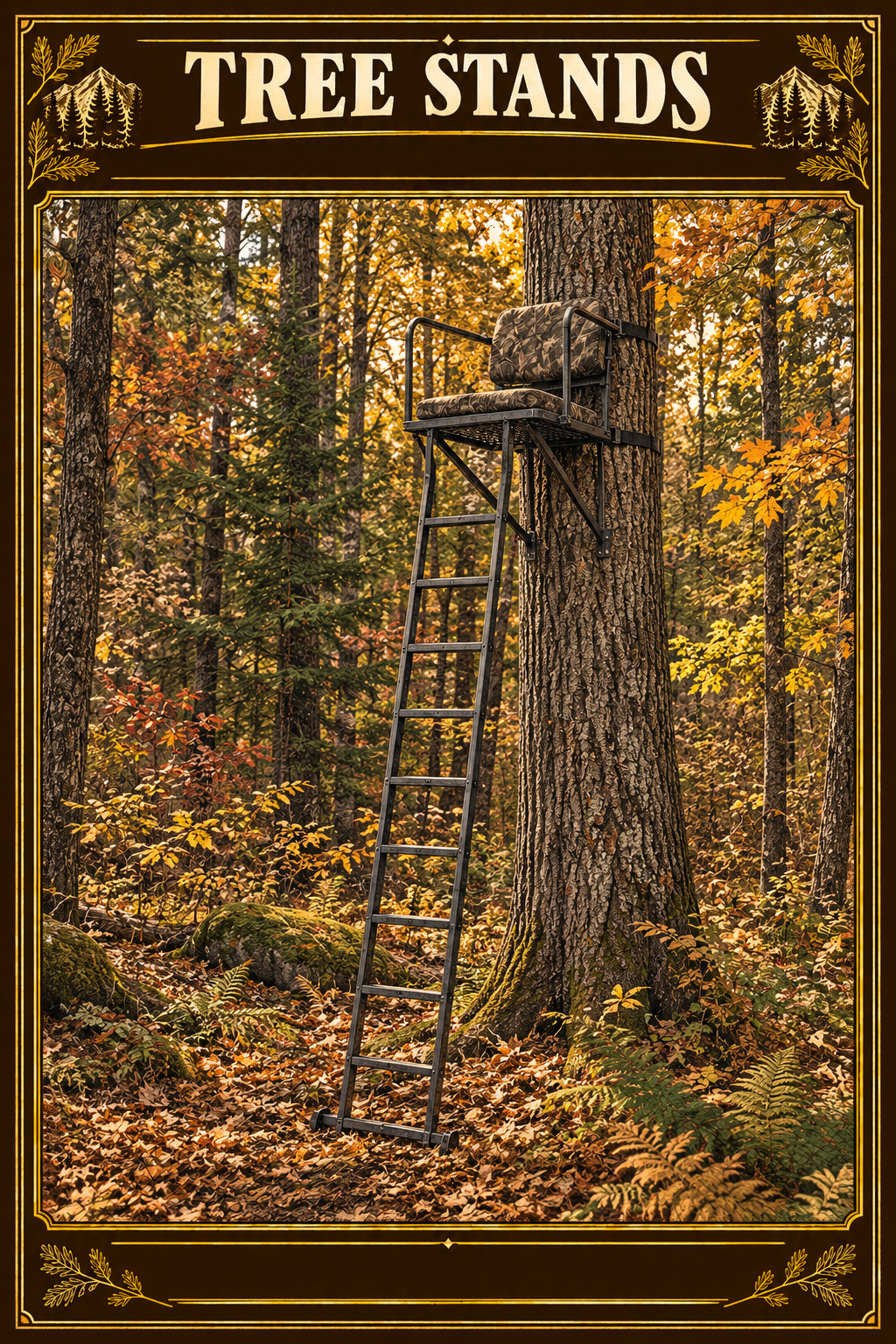
Decide whether an elevated stand fits the hunt
A tree stand can raise a hunter’s view and reduce movement in some settings, but height adds a serious fall hazard and does not guarantee a safe or ethical shot. A ground blind avoids climbing but still needs a sound location, safe sightlines, and awareness of nearby hunters and other land users. You should choose a setup you can reach, use and leave safely in the expected weather and light. If safe access, a safe shooting direction or reliable fall protection is not available, you should use another location or hunt from the ground.
Common stand designs include ladder, fixed-position/hang-on, climbing, and freestanding tower stands. They do not all install or operate the same way. Learn one model at a time and use only its instructions and compatible equipment. A guide or video is not a substitute for an instructor or hands-on training.
Before using a tree stand
- Confirm you have permission to hunt and to place or leave equipment on the land. Check the land manager’s rules about stands, tree damage, dates, labels, storage, and removal.
- Read the stand and fall-arrest-system manuals before assembly or use. Follow their tree-size, user-weight, attachment, compatibility, inspection, and weather limits. Do not modify equipment or substitute an unapproved harness, tether, lifeline, or connector.
- Inspect the platform, ladder or climbing aid, fasteners, straps, welds, tree attachment, harness, stitching, buckles, tether, and lifeline before each use and after storage or severe weather. If any part is damaged, worn, missing, or uncertain, do not climb. Follow each component’s stated retirement or replacement interval, and replace fall-protection components after a fall as their manufacturer directs.
- Choose a healthy, suitable tree within the stand maker’s size limits. Consider dead or hanging branches, decay, lean, unstable ground, wet or icy footing, wind exposure, the approach and exit route, and what other people may be doing nearby.
- Practise setup, climbing, attaching the fall-arrest system, hauling equipment, and descent at low height with an experienced instructor. Learn the equipment’s suspension-relief and emergency procedures on the ground, and keep the specified suspension-relief device accessible on your person; it is not a substitute for prompt rescue.
Climb and descend connected
Use a correctly fitted, compatible full-body fall-arrest system. Follow its manual for connection points and tether length, and remain connected from leaving the ground until both feet are back on the ground. Do not plan to attach only after a slip or fall, and do not improvise a system from unrelated pieces.
Keep three points of contact while climbing ladders or steps, and move deliberately. Do not climb with a bow, crossbow, firearm, backpack, or other gear in your hands or on your back. Use a haul line to raise or lower gear after you are secure; keep firearms unloaded and pointed in a safe direction. Never hoist a loaded firearm. Hoist bows without an arrow nocked; handle crossbows in the safe unloaded/uncocked condition specified by their manufacturer.
Tell someone where you will hunt, where you will park, who is with you and when you expect to return. Keep a charged communication device and a way to signal for help within reach while elevated, and have an emergency plan that accounts for a fall and suspension. Treat a fall or suspension as urgent. Do not rely on a phone alone if there is no service.
Choose and use a ground blind carefully
- Check land access, permission, blind-placement and removal rules, and current visibility/clothing requirements. Rules can apply to archery hunters as well as firearm hunters, and some apply specifically to fabric or synthetic blinds on public land.
- Set the blind on stable ground where entry and exit are clear, away from roads, trails, camps, buildings, property boundaries, and other places where people may be present.
- Identify a safe direction and an adequate backstop for the equipment in use. Know what lies beyond every opening and where other hunters are positioned. Never shoot at a sound, movement, or partly obscured shape.
- Keep windows and exits arranged so you can see and leave safely. Enter and exit slowly, keeping equipment controlled and pointed in a safe direction.
- Make the blind visible to other people whenever local rules require it; camouflage does not replace required blaze-orange/pink material or clothing. Tell partners exactly where the blind is and agree on safe zones.
- Do not use a tree stand, blind, or tree as shelter during a thunderstorm. Follow the lightning guidance in Backcountry & Partner Safety and leave an elevated position early when conditions call for it.
Ventilation and heaters
A fabric blind is an enclosed or partly enclosed space. Carbon monoxide from fuel-burning equipment cannot be seen or smelled. You should avoid fuel-burning heaters, lanterns and stoves inside a blind, dress for the conditions and use battery lighting. A partly opened window does not establish that an enclosed setup is safe.
Rules vary by place
Do not copy a public-land rule from one jurisdiction to another. For example, Minnesota and Wisconsin have different detailed requirements for blaze material on fabric or synthetic ground blinds on public land, and Manitoba’s current general regulation sets specific dates for placing and removing a tree stand or blind on Crown land. Check the current regulation and land manager for the exact property, season, species, and method.
Sources for this lesson (10)
- Wisconsin DNR: Tree stand safety ↗
- Minnesota DNR: Tree stand safety ↗
- Minnesota DNR: 2026 hunting season safety reminder ↗
- Wisconsin DNR: Ground-blind and hunter safety rules ↗
- Manitoba: General Hunting Regulation, tree stands and blinds ↗
- U.S. CPSC: Portable heaters and camping equipment ↗
- PHAC: Carbon monoxide prevention ↗
- Summit: Model-specific manual repository ↗
- Summit: Inspecting and retiring harness-system components ↗
- Summit: Published Featherweight hang-on manual ↗
See every cited website in Sources & Further Reading. Listing an organization does not imply its endorsement of this guide.
This site is free — brand partnerships coming soon.
Sources & Further Reading · General educational information only. Always follow current local hunting regulations and verify ammunition performance with the manufacturer.