
Camp Night-Sky Guide: Constellations and Other Night-Sky Sights
A simple naked-eye activity for a clear evening in camp. The seasonal suggestions are approximate for mid-northern latitudes (about 25°–50° N) in the evening; what you can see depends on latitude, date, time, horizon, cloud, daylight and light pollution.
Optional learning · Enjoy the Hunt
How to use this guide
In far northern summer, twilight may leave little or no full darkness, and some listed constellations sit low or are not visible at a given time. Use a current star wheel or sky chart set for your location, date, and time to confirm what should be above your horizon.
First find a broad, recognizable pattern rather than trying to connect every dim star. Give your eyes time to adjust, use a dim red light if you need to read a chart, and turn the chart so its marked horizon matches the direction you are facing. Binoculars are optional; many of these patterns are easiest to learn with the unaided eye.
Navigation boundary: Constellations are for observation and camp enjoyment. Do not use this guide or the stars as a substitute for a map, compass, GPS, local navigation knowledge, or an emergency plan. Polaris can indicate the direction of true north in the Northern Hemisphere, but it does not tell you your exact location or a safe route.
Seasonal pattern finders
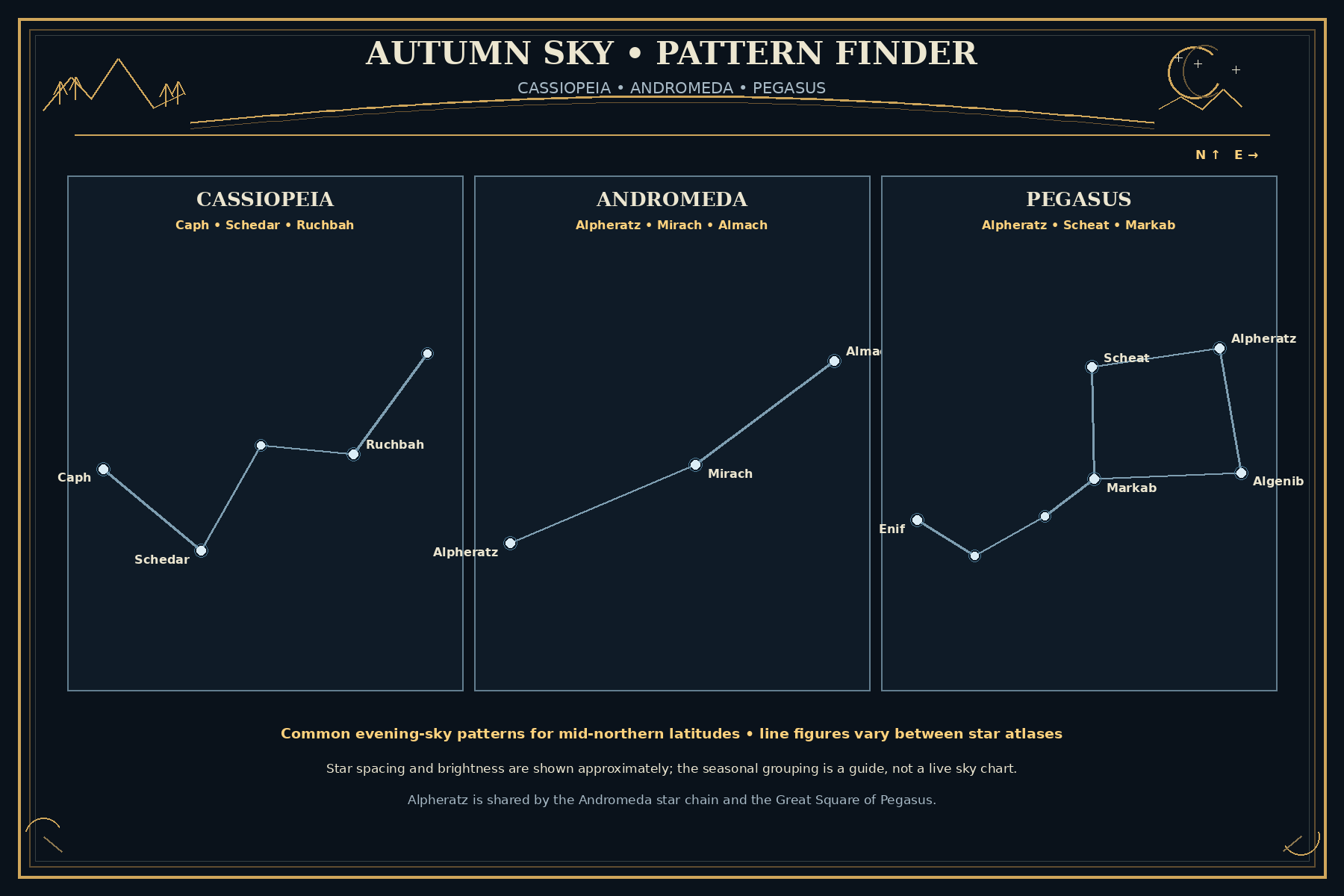
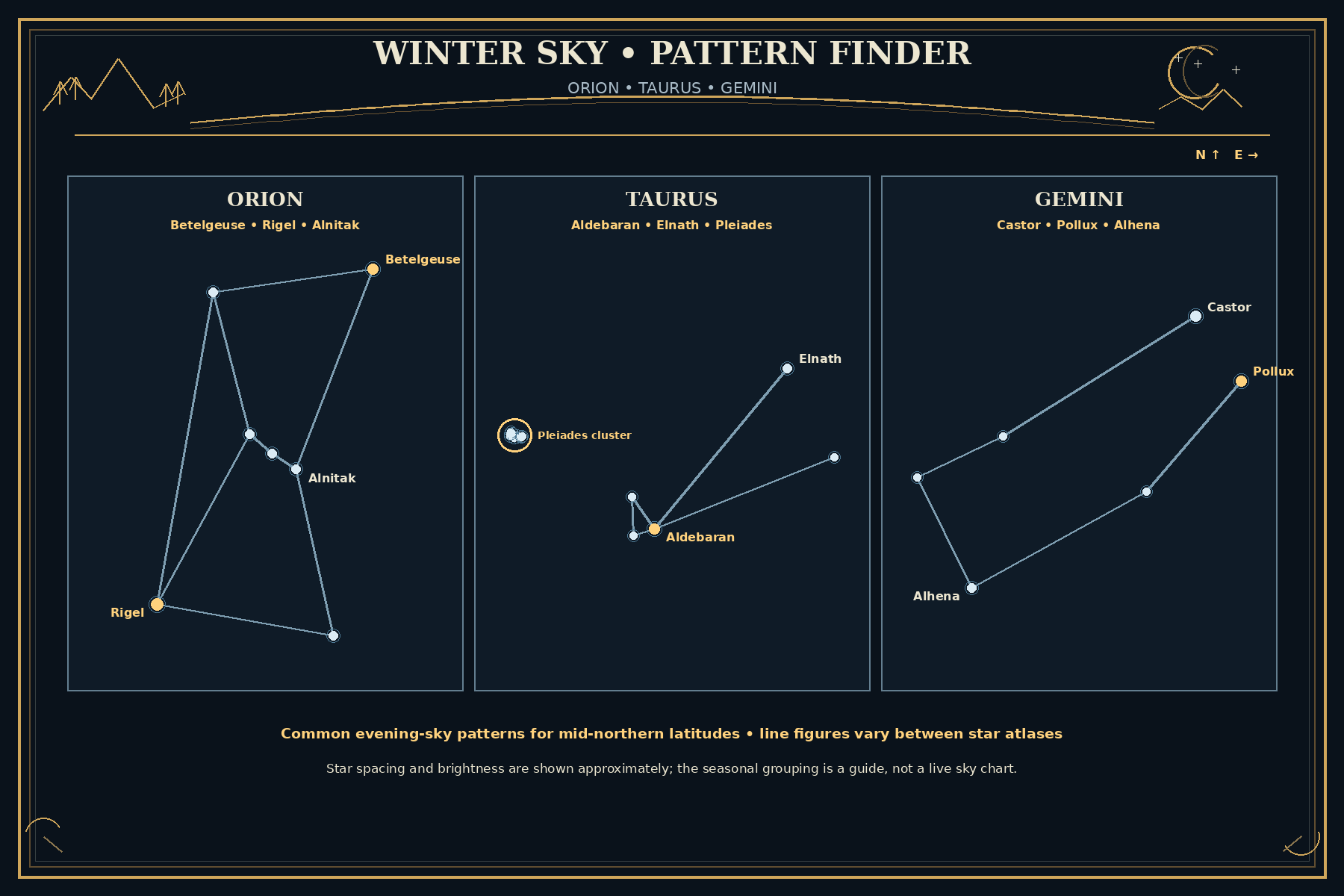
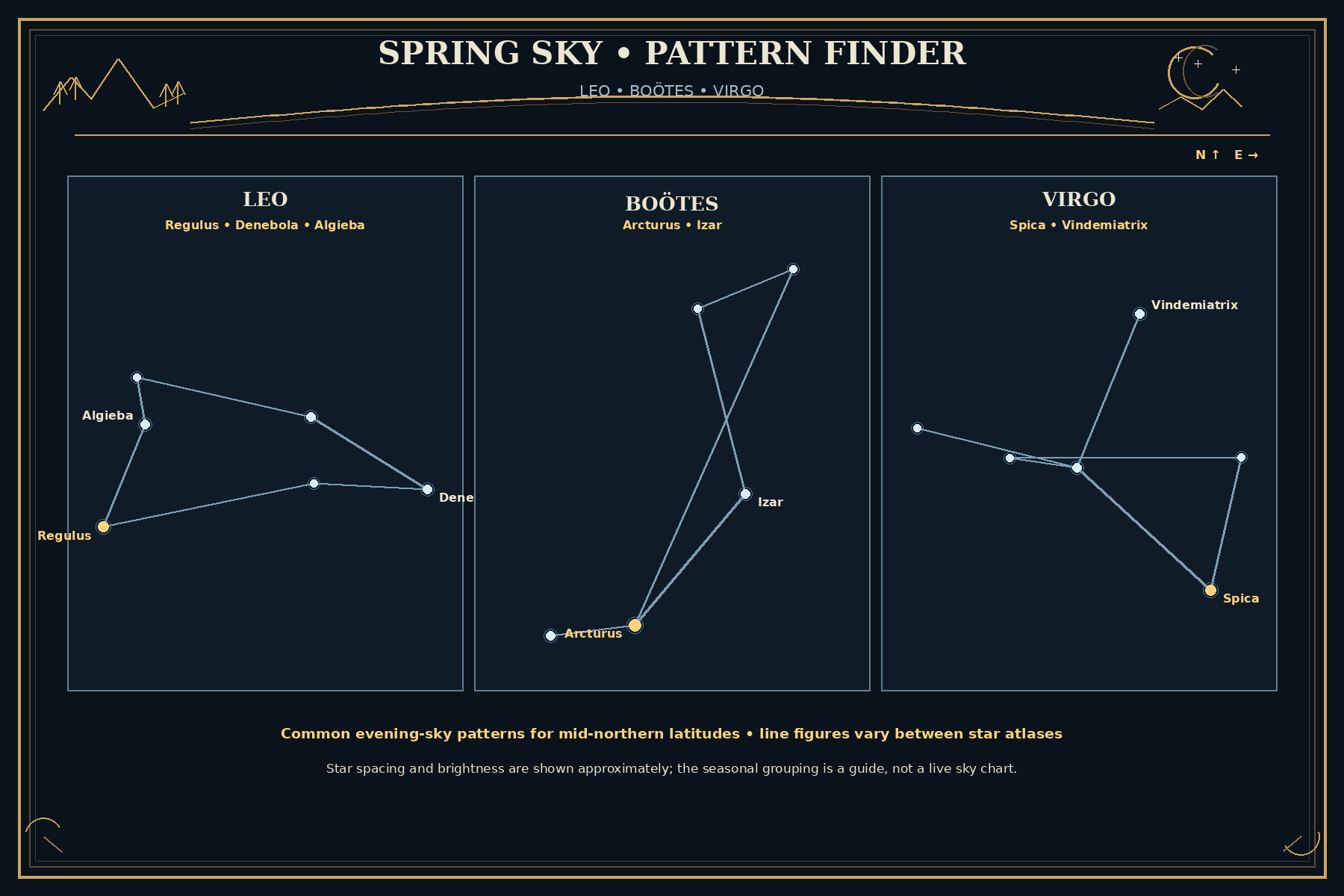
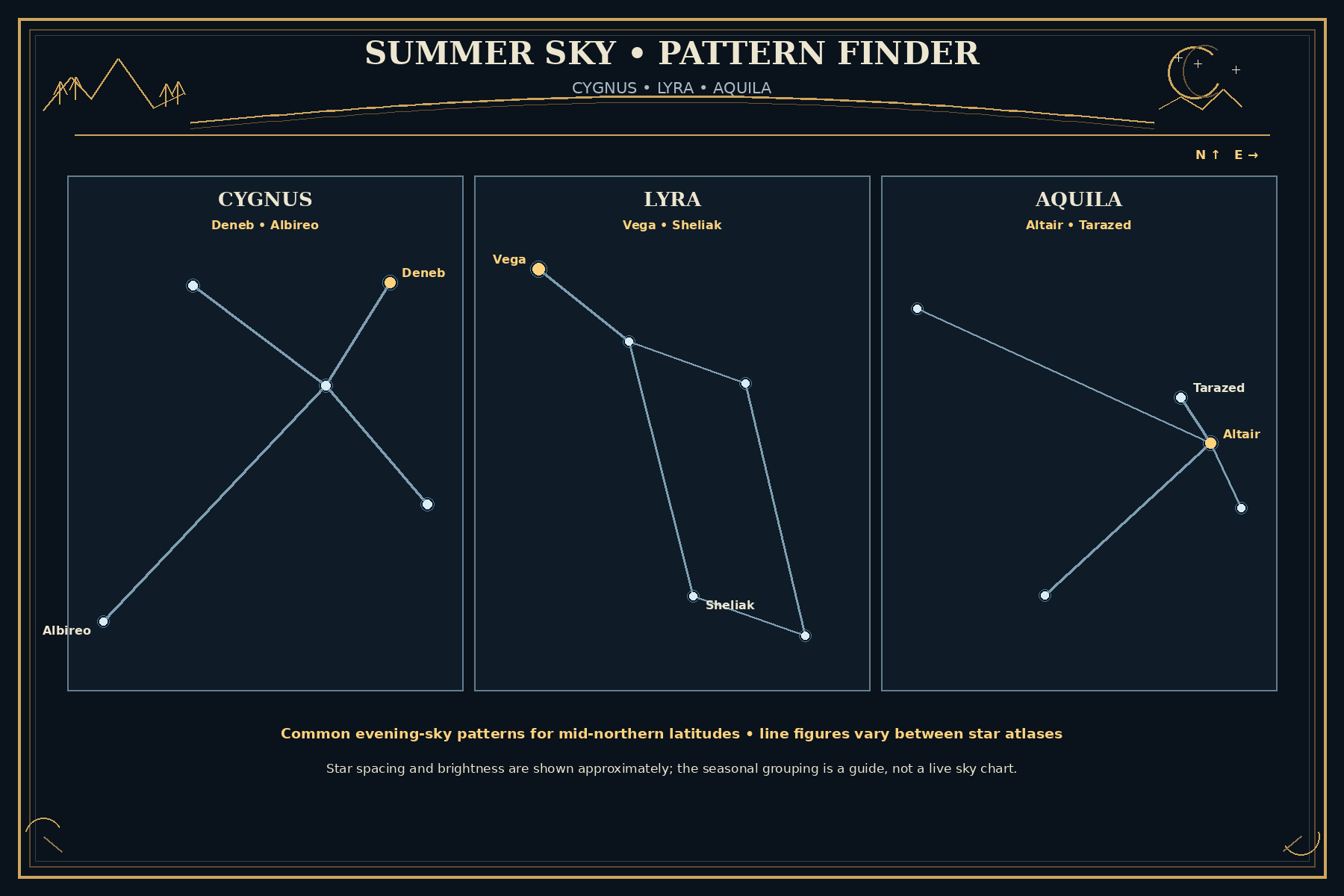
Four seasonal plates show broad mid-northern evening groupings with selected star names. Traditional line figures vary by atlas, and these are not live horizon charts or navigation aids. Open any plate at full size for legible labels.
Seasonal starting points
Season labels are guides, not fixed rules. The same constellation rises earlier each night as the year moves on. The Big Dipper is an asterism within Ursa Major, not a separate constellation; its position changes around Polaris through the night and seasons.
Text version of the four seasonal plates
- Autumn
- Cassiopeia — Caph and Schedar anchor the five-star W or M. Andromeda — start at Alpheratz and follow the star chain through Mirach. Pegasus — look for the large Great Square; Alpheratz belongs to Andromeda.
- Winter
- Orion — Betelgeuse, Rigel, and Alnitak help locate the hunter; start with the three Belt stars. Taurus — Aldebaran and Elnath anchor the bull; the Pleiades is the nearby star cluster circled on the plate. Gemini — Castor, Pollux, and Alhena identify the bright twin stars and their extended pattern.
- Spring
- Leo — Regulus and Denebola frame the lion; start with its sickle-shaped head. Boötes — follow the Big Dipper’s handle arc to Arcturus and the kite-like outline. Virgo — continue past Arcturus to bright Spica.
- Summer
- Cygnus — Deneb, Sadr, and Albireo trace the Northern Cross through the Milky Way. Lyra — start at Vega and look for the small parallelogram beside it. Aquila — Altair, Alshain, and Tarazed form the eagle’s central line and one point of the Summer Triangle.
Polaris, the North Star: your northern-sky landmark
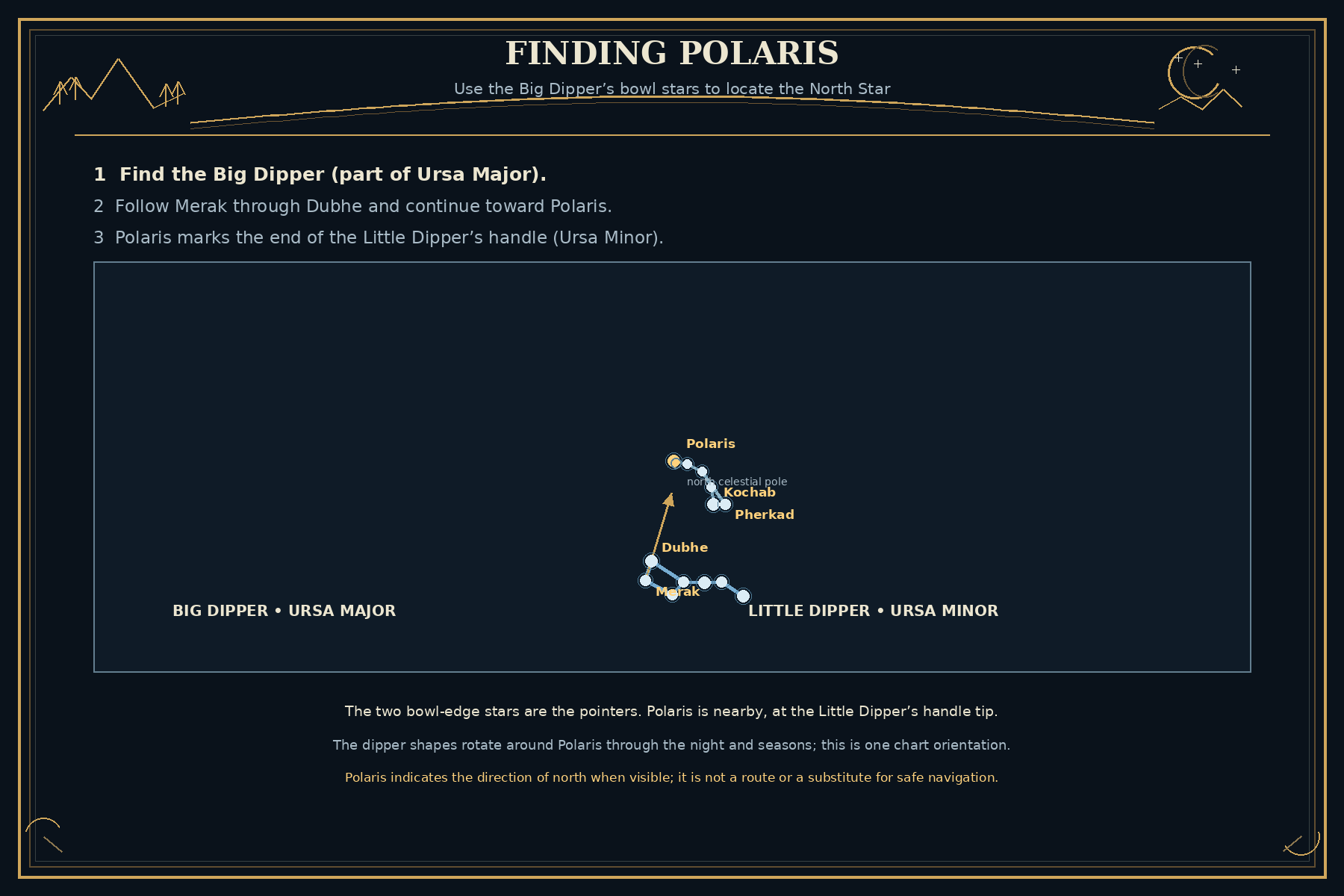
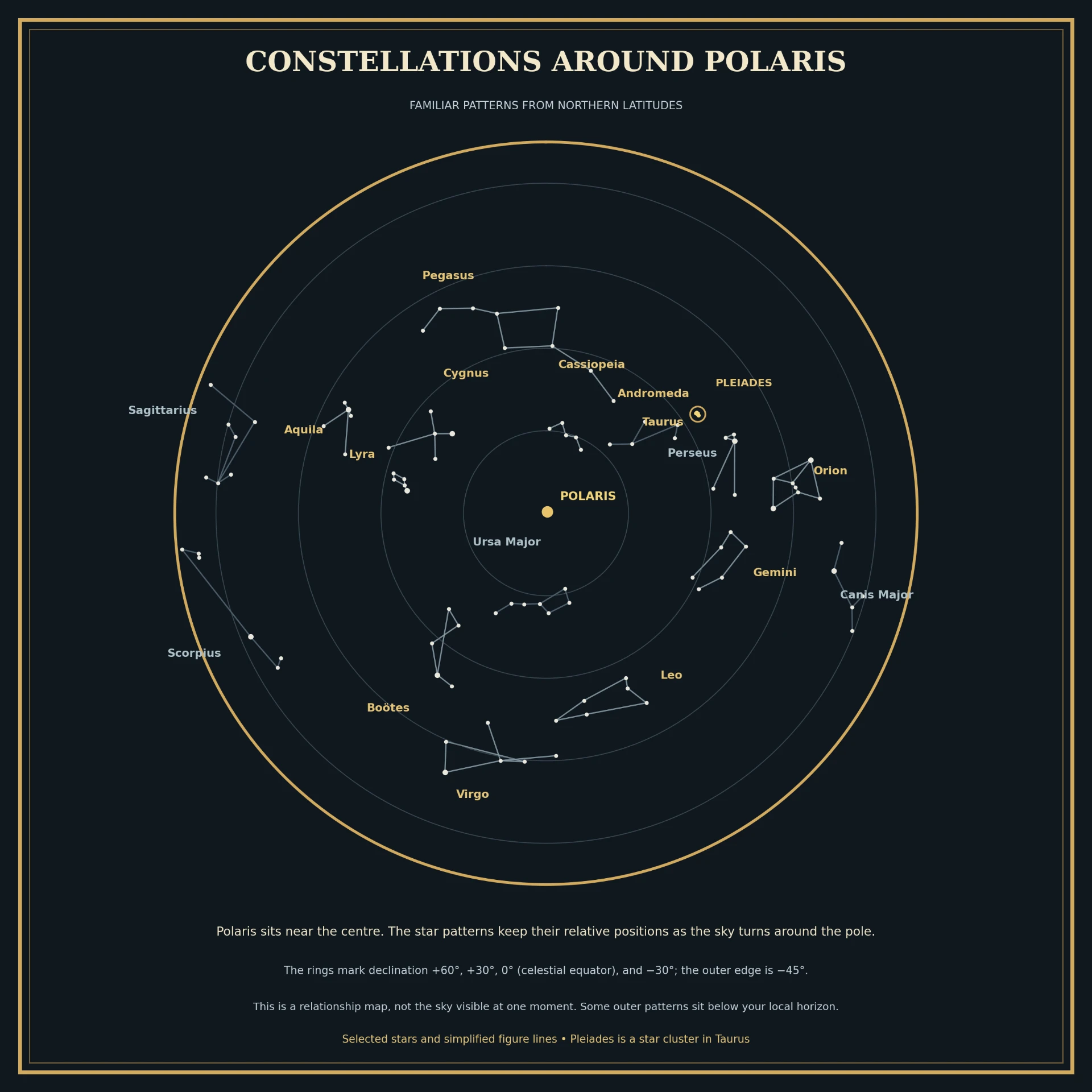
Polaris is the star at the end of the Little Dipper’s handle, in Ursa Minor. It lies very close to the north celestial pole, so as Earth turns, most stars appear to sweep around it while Polaris appears to move only a small amount. It is not the brightest star in the sky, but it is a useful, recognizable landmark in the Northern Hemisphere.
- Find the Big Dipper, a familiar seven-star pattern that is part of Ursa Major. It may be low, high, or turned on its side depending on the season, time, and your location.
- Find the two stars at the outer edge of the Dipper’s bowl, opposite the handle. These are often called the pointer stars.
- Imagine a straight line through the two pointer stars and extend it away from the bowl. That line leads to Polaris.
- If the sky is dark enough, trace the smaller, fainter Little Dipper around Polaris; Polaris is at the end of its handle.
What Polaris can and cannot tell you
When you face Polaris, you are facing approximately toward geographic (true) north. At lower northern latitudes, Polaris appears low above the northern horizon and may be hidden by trees, hills, buildings, cloud, or haze. The “North Star” title is also not permanent: Earth’s axis slowly changes orientation over roughly 26,000 years.
Limits: Polaris gives a rough direction cue when visible; it does not identify your position, show a safe route, account for magnetic compass declination, or replace a map, compass, GPS, trip plan, or navigation training. Do not leave a safe location or cross hazardous ground to try to see it.
Annual meteor showers
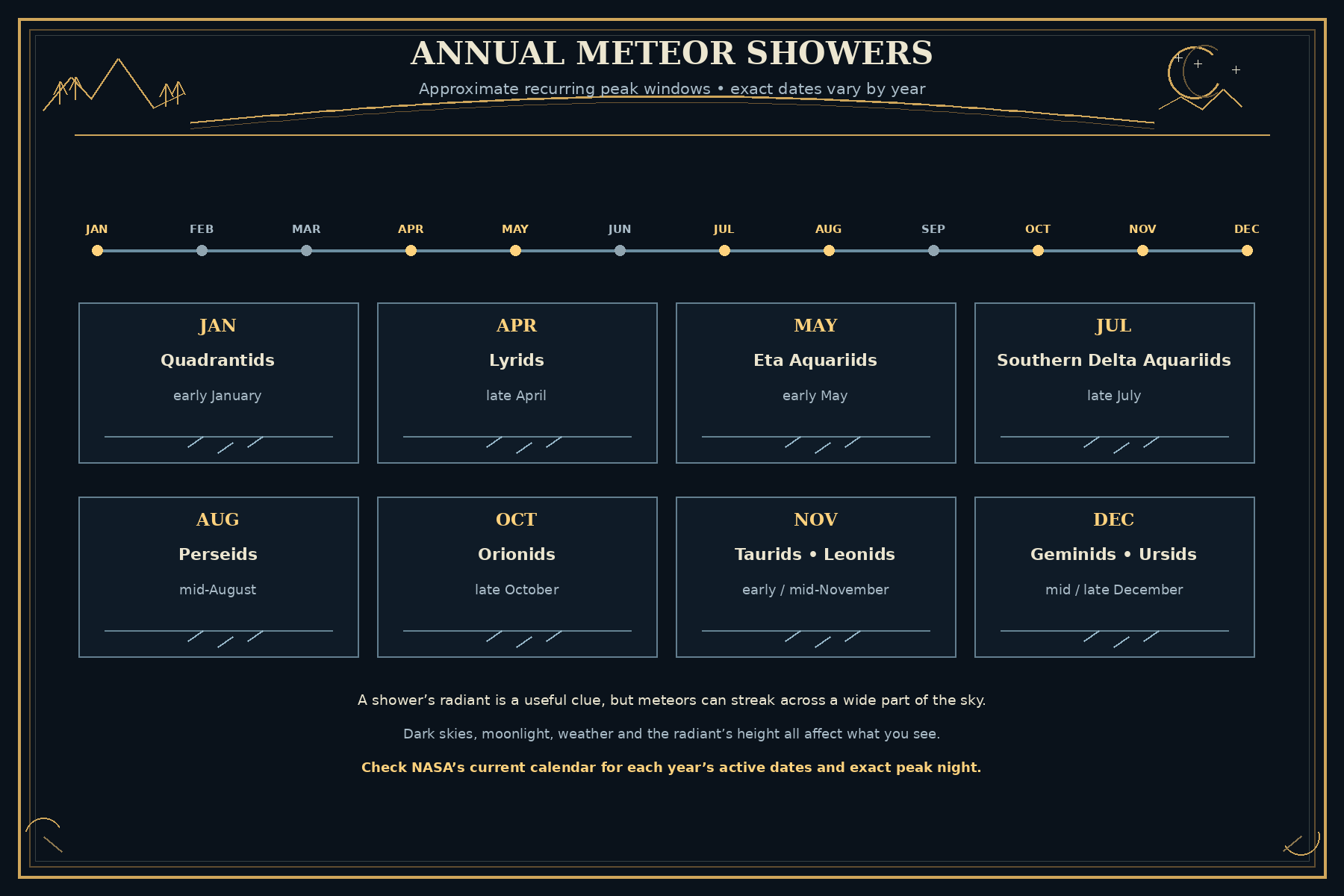
These are annual showers, not guaranteed shows. The number visible varies with the year, location, radiant height, weather, light pollution, and moonlight. A bright Moon can wash out fainter meteors. Meteors can streak across a wide part of the sky, so do not stare only at the radiant.
| Approximate time of year | Annual meteor showers to watch for |
|---|---|
| Early January | Quadrantids; the peak is brief, so check the current forecast. |
| Late April | Lyrids. |
| Early May | Eta Aquariids. |
| Late July | Southern Delta Aquariids. |
| Mid-August | Perseids. |
| Late October | Orionids. |
| Early to mid-November | Taurids and Leonids. |
| Mid to late December | Geminids and Ursids. |
Bright planets: quick recognition
A point of light that seems unusually bright may be a planet rather than a star. Venus is often the brightest planet, and Jupiter can also outshine most stars. Planets usually shine more steadily than stars and slowly change position against the star patterns over days and weeks. Mars can have a subtle orange-red tint. These are clues, not a sure identification; the bright star Sirius can be mistaken for a planet. Mercury, Venus, Mars, Jupiter, and Saturn are commonly visible without a telescope, but their visibility changes with date and time, so use a current local sky chart.
- The Moon: its cycle moves through new Moon, waxing crescent, first quarter, waxing gibbous, full Moon, waning gibbous, last quarter, and waning crescent, repeating in about 29.5 days. Bright moonlight can make faint stars, the Milky Way, and meteors harder to see.
- The Milky Way: it needs a dark sky and a favourable season and viewing direction; latitude, horizon, smoke, cloud, and moonlight matter.
- Aurora: a possible bonus, especially at higher latitudes, but unpredictable. It is not an annual scheduled event.
- Viewing conditions: cloud, smoke, haze, nearby lights, and the Moon can change what is visible more than any star list. Choose an open place where nighttime access is allowed, and check footing and hazards in daylight.
Practical note: Star viewing is optional. Do not leave camp, cross a road, approach a cliff or shoreline, or enter closed or private land to improve a view. Use a light as needed to move safely, then dim it again when stationary.
Eclipses visible from North America, 2027–2032
Eclipse visibility changes greatly from place to place. These are regional highlights, not a promise that every reader can see every event. Recheck the NASA or Canadian Space Agency local map before each date.
- August 2, 2027 — total solar eclipse elsewhere; partial in a small area of eastern Canada and far northern Maine. Most of North America is outside the partial zone.
- January 26, 2028 — annular solar eclipse elsewhere; partial at sunrise in eastern North America. A small, low-altitude partial at the region’s eastern edge.
- January 14, 2029 — partial solar eclipse. Broad visibility across North America, with the amount obscured varying by location.
- June 12, 2029 — partial solar eclipse. Mainly Alaska and northern Canada.
- June 25–26, 2029 (local date varies) — total lunar eclipse. Visible across much of the Americas.
- December 20, 2029 (local date may differ) — total lunar eclipse. The Americas are in the visibility region, but moonrise can limit visible stages in North America.
- June 1, 2030 — annular solar eclipse elsewhere; partial in Alaska.
- November 14, 2031 — hybrid solar eclipse. The central track reaches Panama; partial phases extend over the southern United States and Central America.
Eye safety: A total lunar eclipse is safe to view with the unaided eye. A partial solar eclipse must be viewed through safe solar filters made for eclipse viewing; ordinary sunglasses are not safe. During a total solar eclipse, direct viewing without a filter is safe only during the brief total phase and only inside the path of totality. Follow current NASA/CSA guidance and inspect equipment before use.
About names and stories
The story notes below are selected Greek or Greco-Roman traditions. They are short orientation points, not definitive versions of ancient stories and not universal explanations of the sky. People across cultures have interpreted star patterns in different ways, and many communities maintain their own sky knowledge, names, teachings, and relationships to the stars. This guide does not relabel or retell any Nation’s or community’s knowledge as generic “Native American” or “First Nations” mythology.
Condensed Greek and Greco-Roman story notes
- Cassiopeia
- In Apollodorus’s Greek story, Queen Cassiopeia boasts that her beauty surpasses the Nereids. Poseidon responds with a flood and a sea monster, and an oracle says Andromeda must be offered to the monster. Ancient tellings do not agree on every detail. (Apollodorus, Library 2.4.3.)
- Andromeda
- Andromeda is chained by the shore as a sacrifice to the sea monster. Perseus arrives after his victory over Medusa, kills the monster, and frees her; in Apollodorus’s account, he later marries her. (Apollodorus, Library 2.4.3.)
- Pegasus
- Hesiod says the winged horse Pegasus sprang from Medusa when Perseus cut off her head. Later, Bellerophon rides Pegasus to fight the fire-breathing Chimera. (Hesiod, Theogony 280–325; Apollodorus, Library 2.3.2.)
- Orion
- Orion has several incompatible death stories. One tale preserved by Hyginus says Orion boasted he could kill every creature on Earth; a scorpion was sent against him, and the two were placed in the sky so the Scorpion rises as Orion sets. This is one version, not the only one. (Hyginus, Astronomica 2.26.)
- Taurus
- In one well-known Greek story, Zeus takes the form of a gentle white bull and carries Europa across the sea to Crete. The constellation’s identity has more than one explanation. (Apollodorus, Library 3.1.1; Ovid, Metamorphoses 2.833–875.)
- Gemini
- Castor and Pollux are twin brothers, but Castor is mortal while Pollux is Zeus’s immortal son. After Castor is killed, Pollux refuses to keep immortality without him, and Zeus lets them share their time between the divine world and the world of the dead. (Apollodorus, Library 3.11.2.)
- Leo
- The Nemean lion cannot be killed with ordinary weapons. Heracles traps and strangles it, then wears its hide; later sky lore identifies Leo with that lion. (Apollodorus, Library 2.5.1.)
- Boötes
- Boötes is often called the Bear-Watcher because the figure follows Ursa Major around the northern sky. Later mythographers identify the figure in different ways, so no single human character is certain. (Aratus, Phaenomena 91–136; compare Hyginus, Astronomica 2.4.)
- Virgo
- Aratus tells of Justice, Dike, who once lived among people and settled disputes. As people became more violent and unjust, she withdrew and took her place among the stars. Later writers connect the Maiden with other figures. (Aratus, Phaenomena 96–136.)
- Cygnus
- One tale says Zeus took a swan’s form when he approached Leda; another tells of Cycnus, who grieved for Phaethon and became a swan. No single story is the agreed origin. (Apollodorus, Library 3.10.7; Ovid, Metamorphoses 2.367–380.)
- Lyra
- Orpheus’s music could move animals, people, and the guardians of the Underworld. He persuades the rulers of the dead to let Eurydice follow him back, but turns too soon and loses her. Hyginus says the Muses placed his lyre among the stars. (Ovid, Metamorphoses 10.1–85; Hyginus, Astronomica 2.7.)
- Aquila
- In one story, Aquila is Zeus’s eagle, which carries the Trojan youth Ganymede to Olympus. Other accounts assign different deeds to the eagle. (Hyginus, Astronomica 2.16; compare Apollodorus, Library 3.12.2.)
- Ursa Major and the Big Dipper
- One Greek story identifies the Bear as Callisto, a follower of Artemis transformed into a bear. Her son Arcas nearly kills her while hunting, and Zeus places mother and son among the stars. Other authors tell it differently. (Apollodorus, Library 3.8.2; Aratus, Phaenomena 27–44.)
- Perseus
- Perseus brings back Medusa’s head by avoiding her direct gaze, then frees Andromeda from the sea monster. In Hesiod’s account, Pegasus springs from Medusa at that moment. (Apollodorus, Library 2.4.2–3; Hesiod, Theogony 280.)
- Scorpius
- One late Greek-Roman story links Scorpius to Orion: after the hunter claims nothing can escape him, the scorpion kills him, and the two are set on opposite sides of the sky. Other sources give Orion different deaths. (Hyginus, Astronomica 2.26.)
- The Pleiades
- The Pleiades are the seven daughters of Atlas and Pleione. In one story, Orion pursues them and the gods turn the sisters into doves and set them among the stars. Other versions exist. (Apollodorus, Library 3.10.1; Hyginus, Astronomica 2.21.)
Sources for this lesson (22)
- NASA: Create a Star Wheel ↗
- NASA: Asterisms through the seasons ↗
- NASA: Find Polaris using the Big Dipper ↗
- NASA: Constellations of Alaska ↗
- NASA: Annual meteor showers ↗
- NASA: Finding a good place to stargaze ↗
- NASA: Skywatching FAQ ↗
- NASA: Aurora and other night lights ↗
- International Astronomical Union: Constellations ↗
- NASA: Planetary alignments and planet parades ↗
- NASA: Solar eclipses 2021–2030 ↗
- NASA: Solar eclipses 2031–2040 ↗
- NASA: Lunar eclipses 2021–2030 ↗
- NASA: Lunar eclipses 2031–2040 ↗
- NASA: Future eclipses ↗
- NASA: Eclipse viewing safety ↗
- Canadian Space Agency: Eclipses ↗
- Apollodorus, Library ↗
- Aratus, Phaenomena ↗
- Hyginus, Astronomica ↗
- Hesiod, Theogony ↗
- Ovid, Metamorphoses ↗
See every cited website in Sources & Further Reading. Listing an organization does not imply its endorsement of this guide.
This site is free — brand partnerships coming soon.
Sources & Further Reading · General educational information only. Always follow current local hunting regulations and verify ammunition performance with the manufacturer.