
Understanding Hunting Ammunition
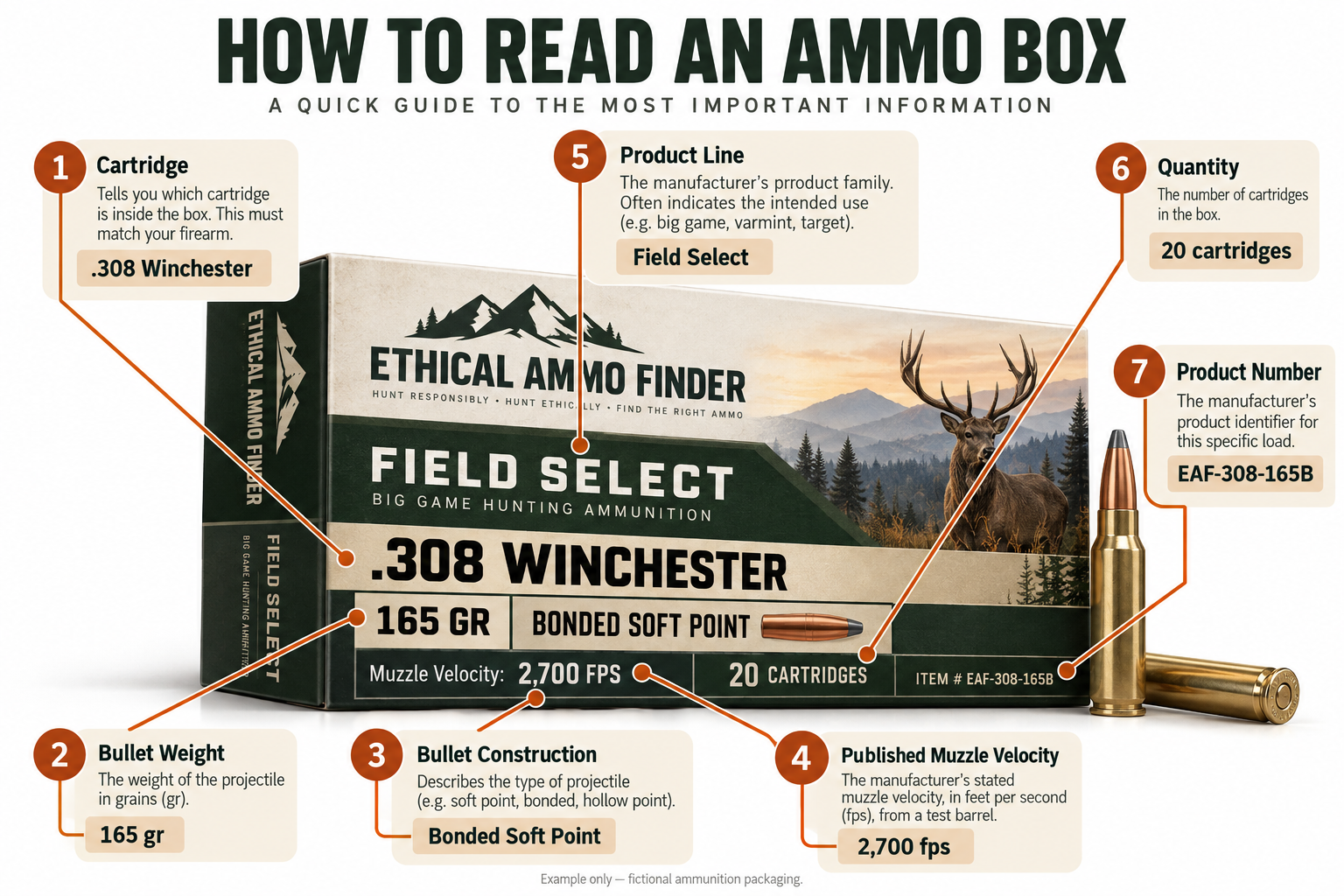
The words and numbers on an ammunition box describe several different things. Learning to separate cartridge, bullet weight, construction and intended application prevents the common mistake of treating one familiar number as the whole story.
 Open full-size image ↗
 Open full-size image ↗
Text version of this diagram
- Cartridge: .308 Winchester.
- Bullet weight: 165 grains.
- Bullet construction: bonded soft point.
- Published muzzle velocity: 2,700 feet per second.
- Product line: Field Select.
- Quantity: 20 cartridges.
- Product number: EAF-308-165B.
The packaging is fictional and illustrates where information may appear; confirm the exact load and firearm compatibility with the manufacturer.
Cartridge and bullet are different
The cartridge is the complete round. The bullet is the projectile it launches. Two loads can use the same cartridge case and very different bullets designed for different jobs.
The headstamp and rifle marking come first
Use only the exact ammunition appropriate for the firearm as specified by its manufacturer. Similar names or cartridges that appear to fit are not a basis for interchangeability.
Grains describe weight, not quality
Bullet weight is commonly expressed in grains. For scale, 1 gram is about 15.4 grains, so a 150-grain bullet weighs about 9.7 grams. A grain and a gram are different units. A heavier bullet is not automatically better, and two bullets of the same weight can behave differently because their construction and intended application differ.
Construction controls much of what happens on impact
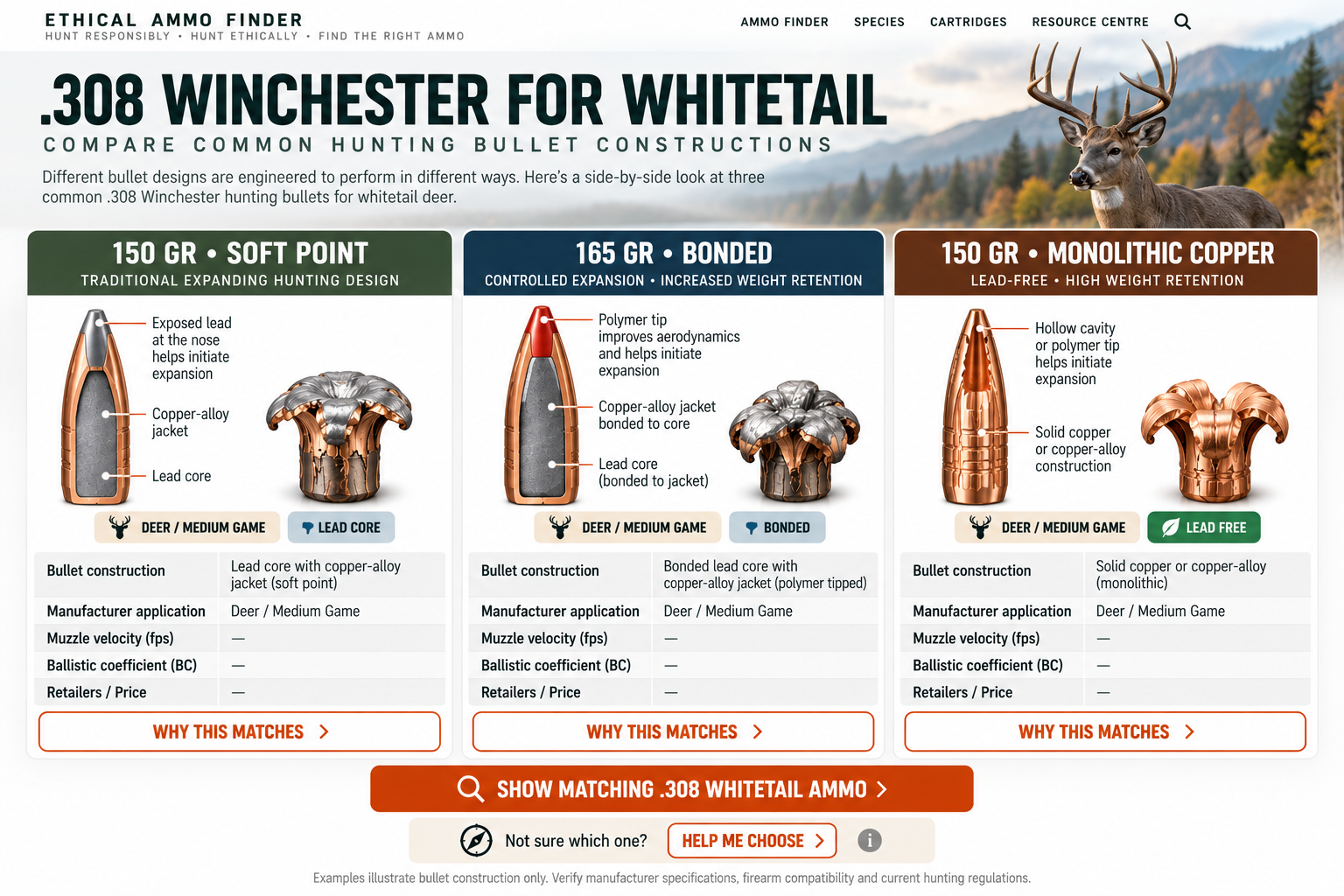
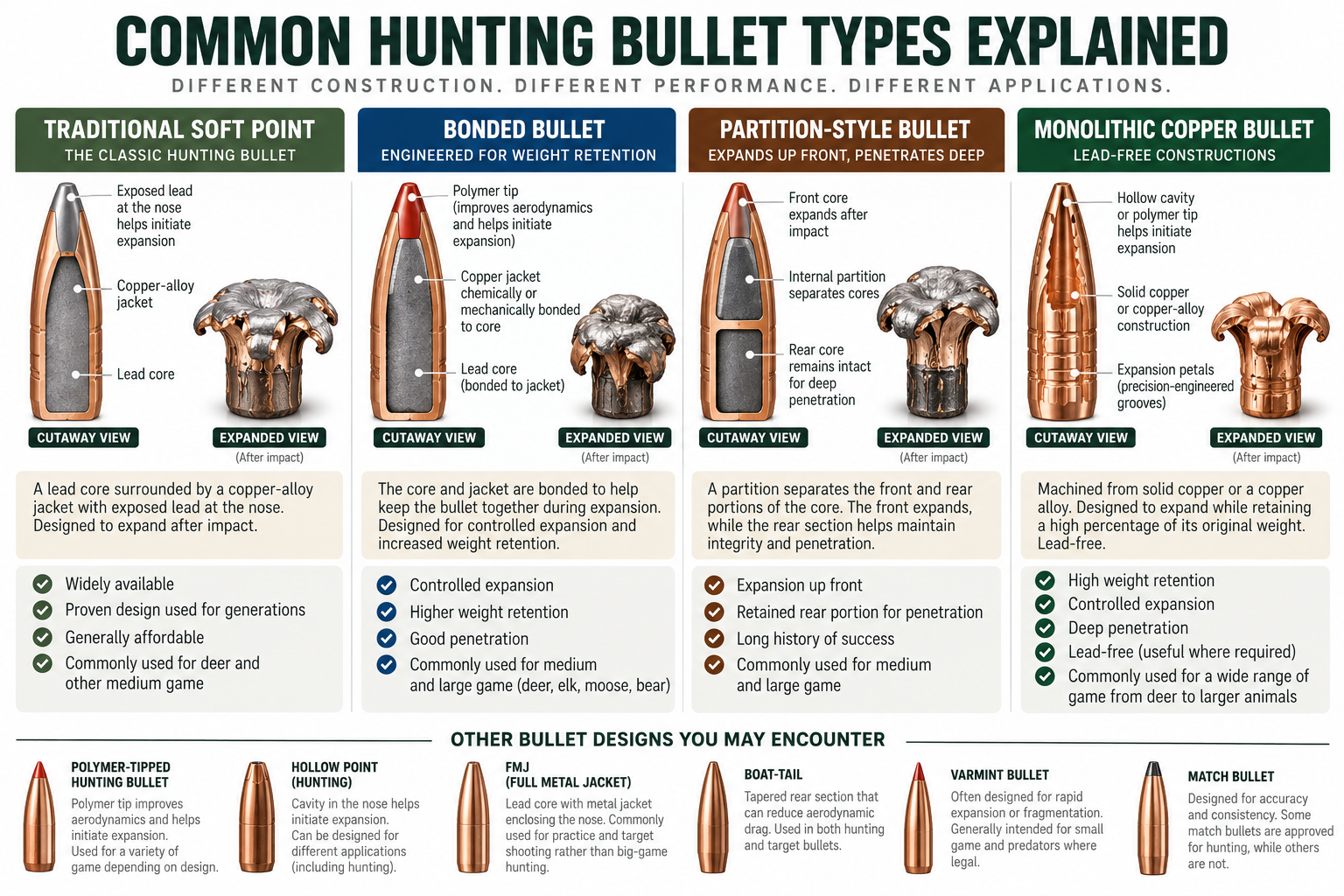
Conventional soft points, bonded bullets, partition-style bullets, tipped hunting bullets and monolithic copper designs manage expansion, penetration and weight retention differently. Learn the design rather than judging by appearance alone.
Manufacturer application is valuable context
Begin with loads the manufacturer identifies for the species or class of game you intend to hunt. That does not remove the need for judgment, but it is stronger evidence than assuming suitability from energy or bullet weight alone.
Velocity: feet per second and metres per second
North American ammunition data commonly gives muzzle and impact speed in feet per second (fps or ft/s); many European and international sources use metres per second (m/s). They describe the same speed: 1,000 fps is about 305 m/s. Muzzle velocity is the speed as the bullet leaves the barrel, often reported from a manufacturer’s test setup. Impact velocity is the estimated speed at a stated distance. Since a bullet slows in flight, compare values at the same point in the trajectory.
Ballistic coefficient: what it tells you
Ballistic coefficient (BC) is a way to describe a bullet’s aerodynamic drag compared with a standard reference shape. It reflects the bullet’s mass relative to its diameter and its shape. A higher BC generally means less slowing from air resistance and, under similar conditions, better velocity retention and less wind drift. BC values depend on the reference model—commonly G1 or G7—and can change with velocity, so compare the same model and note the conditions or velocity attached to a published value. BC helps a trajectory estimate; it does not by itself predict accuracy, expansion, penetration or suitability for game.
Energy and foot-pounds
The homepage graph shows estimated bullet energy over distance. In North American data, energy is commonly expressed in foot-pounds (ft-lb or ft-lbs); metric sources often use joules. Energy depends on bullet weight and velocity, with velocity squared in the calculation, so a change in speed can have a large effect on the number. The graph is one comparison reference; it does not show bullet construction or guarantee how a bullet will perform on an animal. An energy value is not a complete shot decision or a measure of the recoil felt by the shooter.
Recoil (kickback) is part of rifle choice
When a rifle fires, the bullet and propellant gases move forward and the rifle moves back. Recoil depends on that forward momentum and the rifle’s weight; felt recoil also varies with the rifle’s stock fit and design, the load and how the rifle is held. In the same rifle, loads that send a heavier bullet faster generally produce more recoil. A heavier rifle often reduces felt recoil, while adding weight to carry. Recoil is separate from the bullet’s energy downrange. If recoil makes a rifle uncomfortable or harder to practise with consistently, it is a reasonable factor when choosing a rifle and cartridge. When possible, try the specific rifle and load safely at a range before deciding.
Your rifle has a vote
A load that is appropriate on paper still needs to feed, function and shoot consistently in your rifle. Confirm it at the range before treating a ballistic table as proof of field capability.
The useful question is a combination
Instead of asking only ‘What grain should I use?’, ask: Is this the correct cartridge, is the bullet designed for the intended game, does it perform in the relevant velocity range, and can I place it reliably from this rifle?
This site is free — brand partnerships coming soon.
General educational information only. Always follow current local hunting regulations and verify ammunition performance with the manufacturer.