
Tick Awareness
Illustrated adult-female plates with broad Canadian and U.S. location and disease context for hunters spending time in tick habitat.
More than one tick species may occur in a region, and ranges change. A tick found outside its usual range may have travelled on a person, pet, or wildlife. The presence of a tick species does not establish that it is infected or that a person will become ill. Not all ticks carry disease-causing germs; infection depends on the individual tick and the pathogens circulating among hosts. Appearance cannot reveal infection. Use a clear photograph or a local tick-identification service when identification matters, and ask a health professional or veterinarian about exposure concerns.
The locations below distinguish Canadian information from U.S. information. They are broad summaries, not maps of disease risk. The species–pathogen associations listed mean a tick can transmit a pathogen under some circumstances; they do not mean every tick carries it.
Featured plates
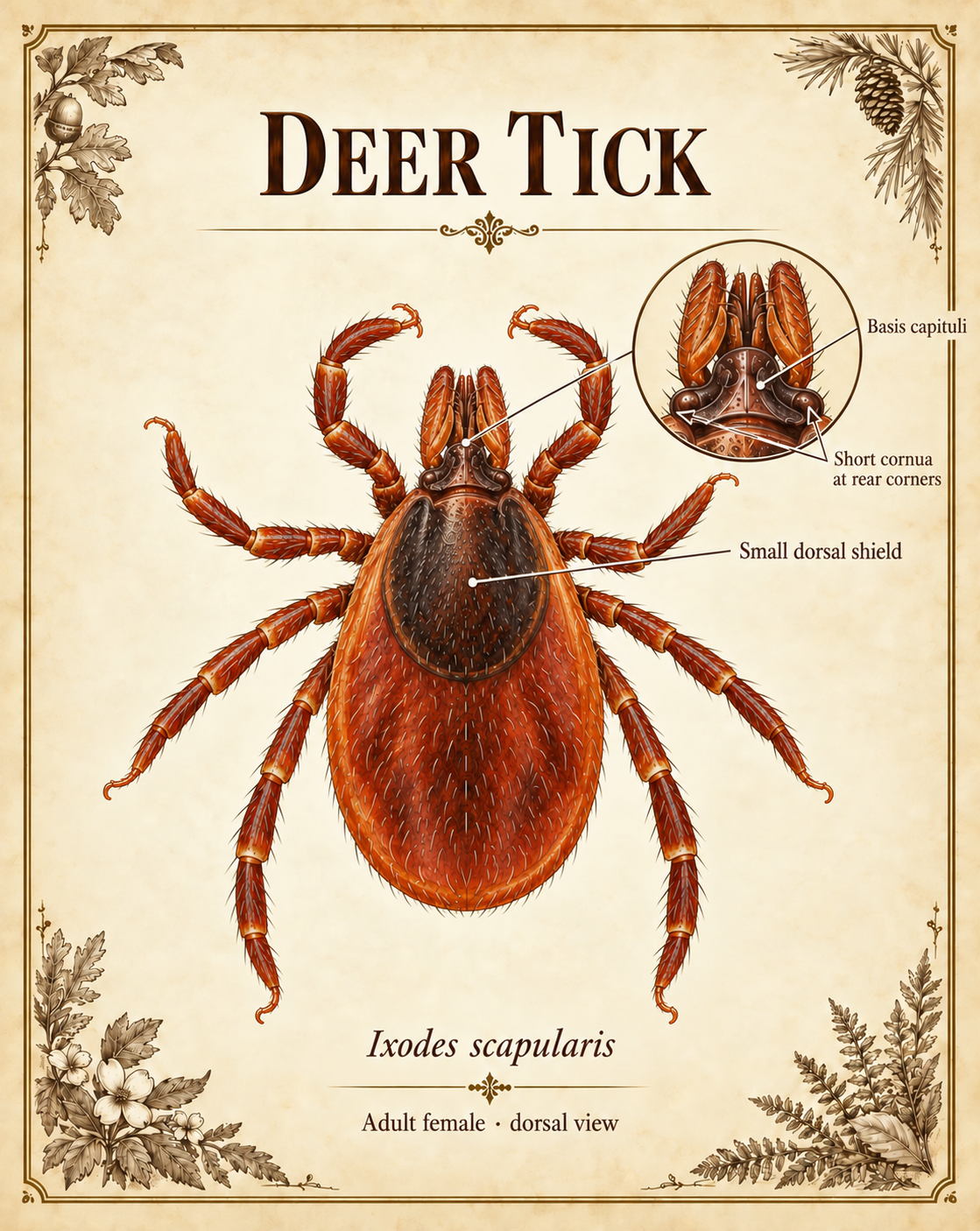
Deer tick / blacklegged tick (Ixodes scapularis)
Adult female · dorsal view · illustrated recognition aid, not proof of species or infection.
Canada: Established populations are reported in parts of Manitoba, New Brunswick, Nova Scotia, Ontario, and southern Quebec; locally suitable habitat and surveillance findings vary. PHAC associates this species with Lyme disease, anaplasmosis, babesiosis, Powassan virus disease, and Borrelia miyamotoi disease. United States: Widely distributed in the East; the CDC also lists Lyme disease, anaplasmosis, babesiosis, Powassan virus, hard-tick relapsing fever, and ehrlichiosis among the infections associated with it. Nymphs and adult females commonly bite people. Do not treat the plate’s colour or one marking as species proof.
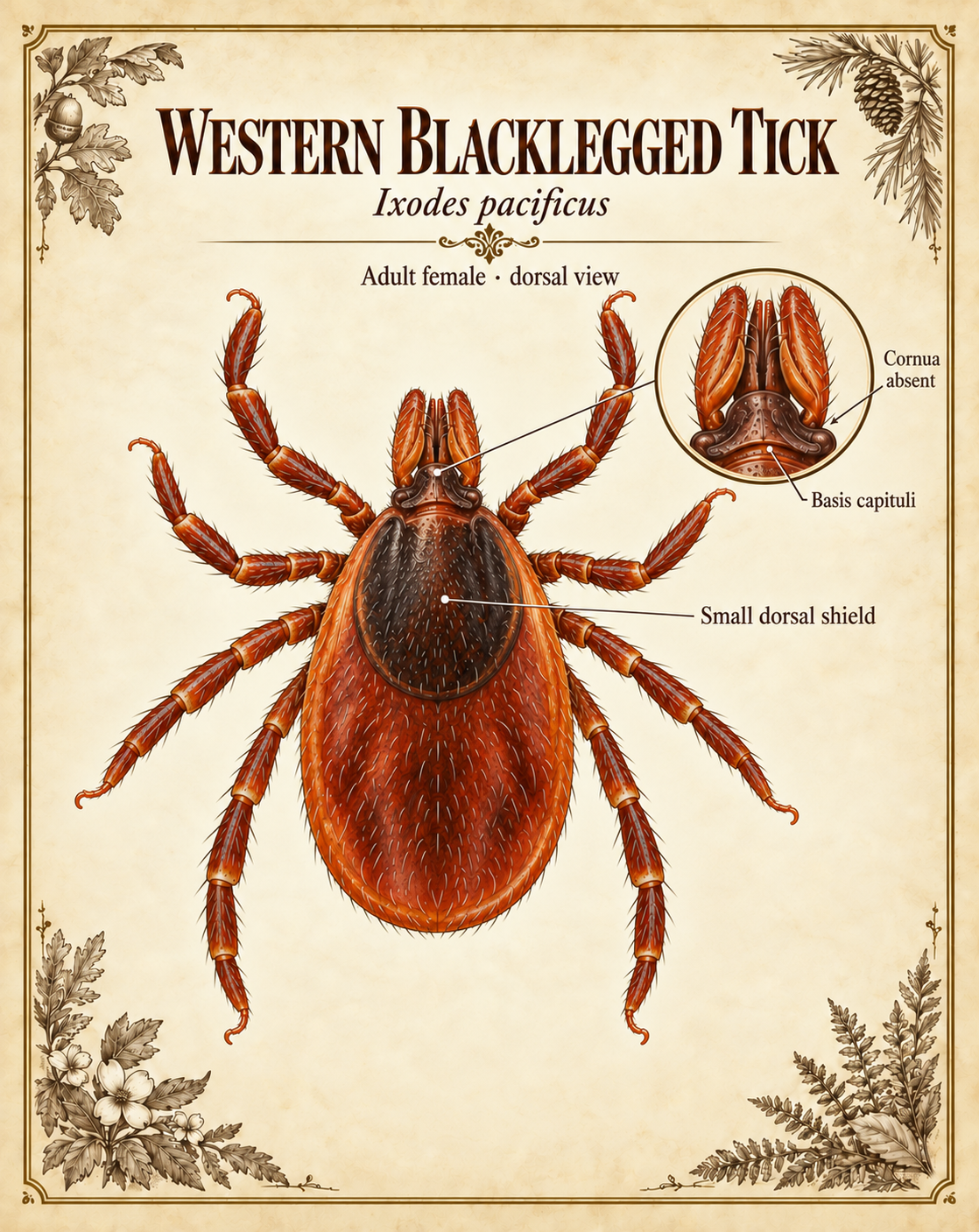
Western blacklegged tick (Ixodes pacificus)
Adult female · dorsal view · illustrated recognition aid, not proof of species or infection.
Canada: Established along coastal and southern-interior British Columbia. PHAC lists Lyme disease, anaplasmosis, and B. miyamotoi disease. United States: Pacific Coast, especially northern California; CDC lists anaplasmosis, Lyme disease, and hard-tick relapsing fever. Adults have long mouthparts, a plain shield without eyes, and no festoons—shared Ixodes traits. The illustration does not establish a reliable visual distinction from I. scapularis; geographic context and comparison with current photographs matter.
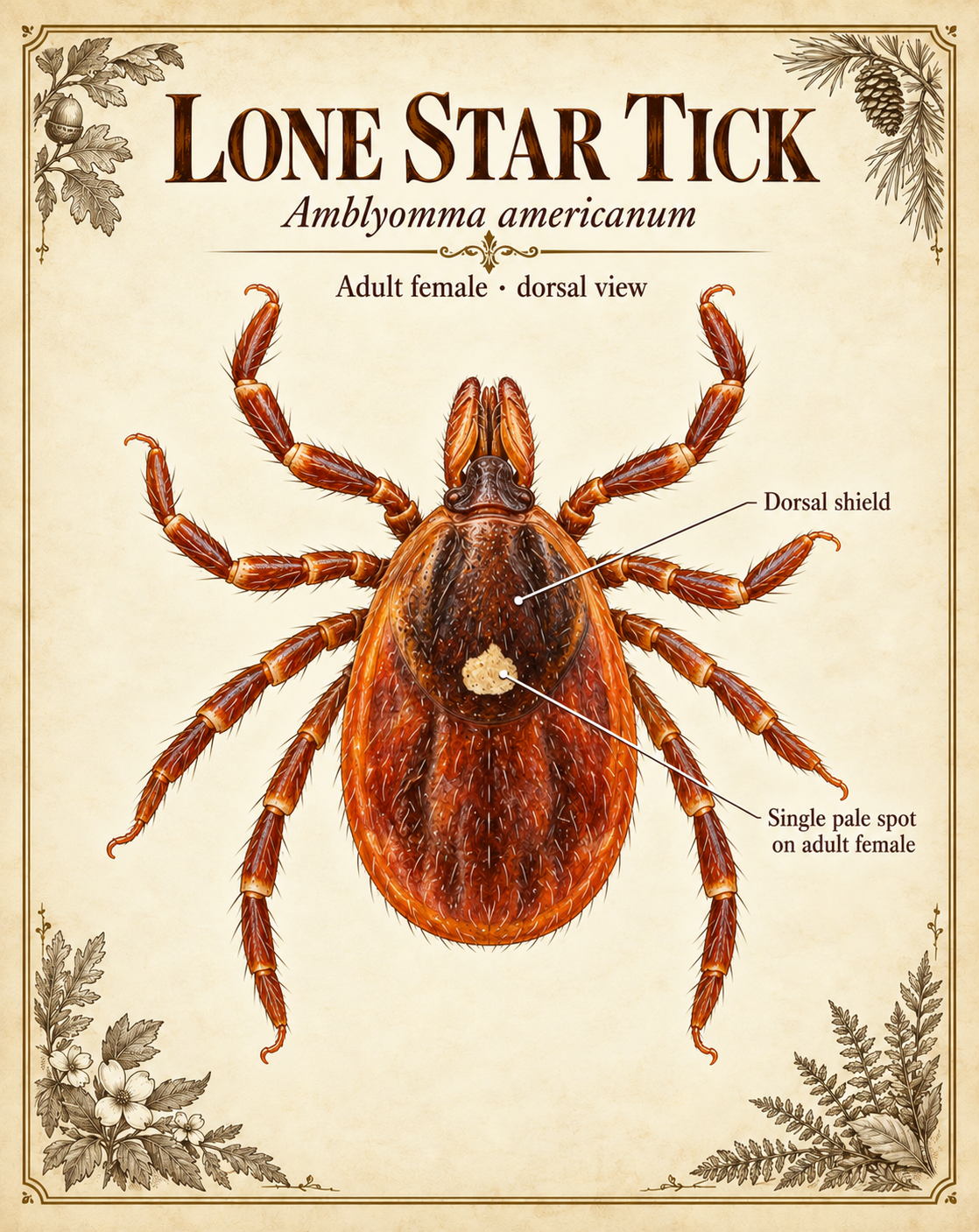
Lone star tick (Amblyomma americanum)
Adult female · dorsal view · illustrated recognition aid, not proof of species or infection.
Canada: Reported in southern areas of Alberta, Manitoba, Nova Scotia, Ontario, Quebec, and Saskatchewan; findings do not mean every area has established populations. PHAC lists tularemia, ehrlichiosis, Bourbon virus disease, Heartland virus disease, and possible alpha-gal syndrome/STARI associations. United States: Widespread in the Northeast, South, and Midwest; CDC associates it with ehrlichiosis, tularemia, Bourbon and Heartland viruses, STARI, and a growing body of evidence linking bites to alpha-gal syndrome. The single pale dorsal spot identifies an adult female clue only; males and immature ticks do not share this feature.
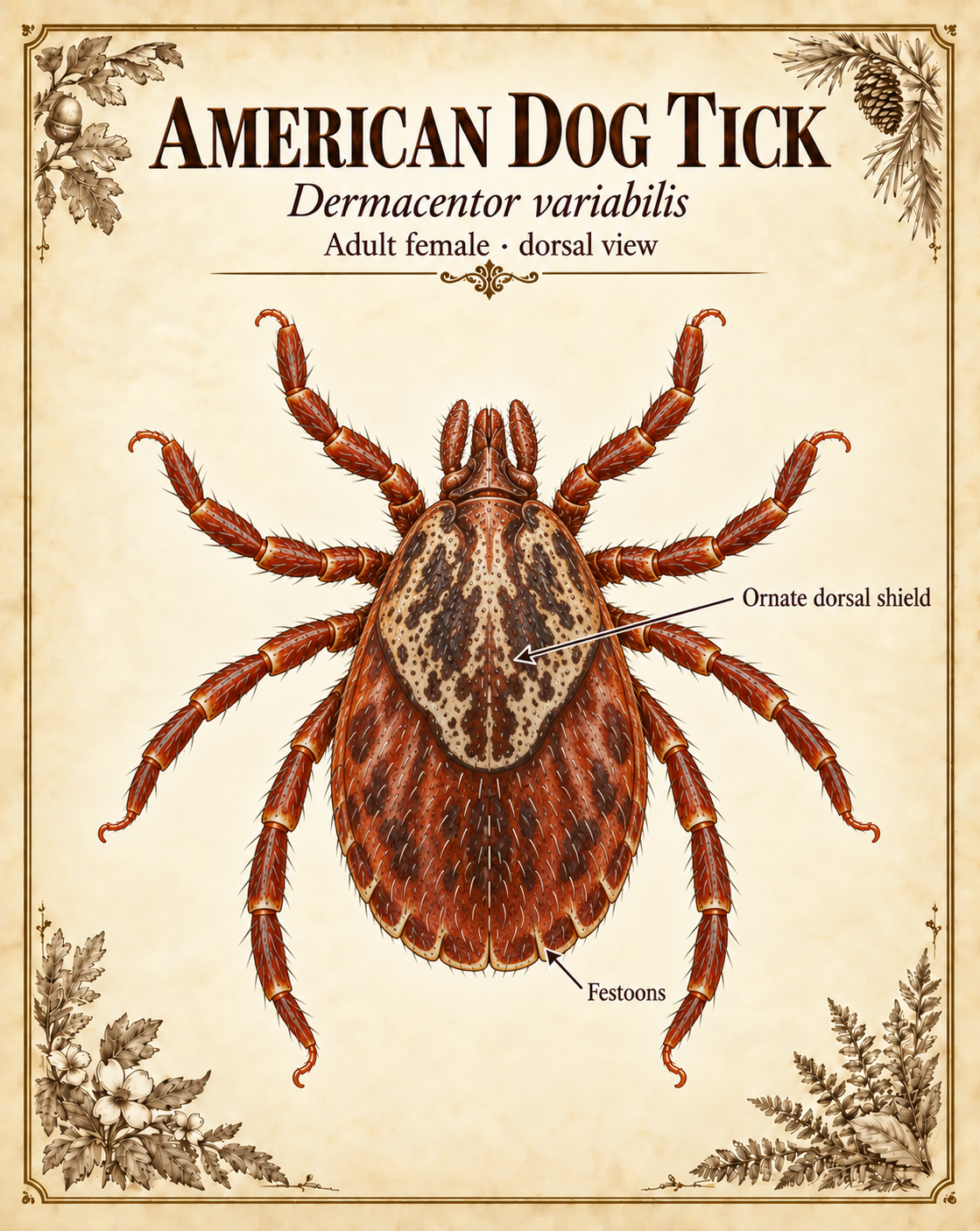
American dog tick (Dermacentor variabilis)
Adult female · dorsal view · illustrated recognition aid, not proof of species or infection.
Canada: Established in parts of south-central and southeastern Canada; PHAC lists tularemia and Rocky Mountain spotted fever. United States: Broadly distributed, particularly east and south; CDC lists Rocky Mountain spotted fever, tularemia, and tick paralysis among relevant associations. The ornate shield and festoons shown are shared Dermacentor traits. Do not use dorsal markings alone to distinguish it from western Dermacentor species.
These drawings are visual memory aids, not a diagnostic key. Tick identification may require life stage, sex, geography, and microscopic characters. Never infer infection from a tick’s appearance. If a bite is followed by symptoms or you are worried about exposure, contact a health professional; for pets or livestock, contact a veterinarian.
Found an attached tick? See the separate Tick Removal guide.
Sources
- Public Health Agency of Canada, Ticks in Canada (checked through the August 7, 2026 update)
- Public Health Agency of Canada, Powassan virus disease: spread, prevention and risks
- CDC, Ticks
- CDC, DPDx: Ticks
- CDC, Where ticks live
- CDC, Powassan virus: how it spreads
- CDC, American dog tick surveillance (checked through July 2, 2026)
- INSPQ, Ixodes cookei or groundhog tick (identification guide to ticks found in Quebec)
- University of Maine Cooperative Extension, Squirrel tick
- Indiana Department of Health, Asian longhorned tick (Haemaphysalis longicornis)
- Egizi et al., North American pictorial key covering the dorsal spur anatomy of Haemaphysalis longicornis, article (PMC)
- Lado et al., “Dermacentor species in western Canada, with detection of Dermacentor similis,” Journal of Medical Entomology (2025), article
Location summaries are broad regional context, not a current risk map. Verify local public-health guidance.
This site is free — brand partnerships coming soon.
Sources & Further Reading · General educational information only. Always follow current local hunting regulations and verify ammunition performance with the manufacturer.