
Hunting Optics & Riflescopes
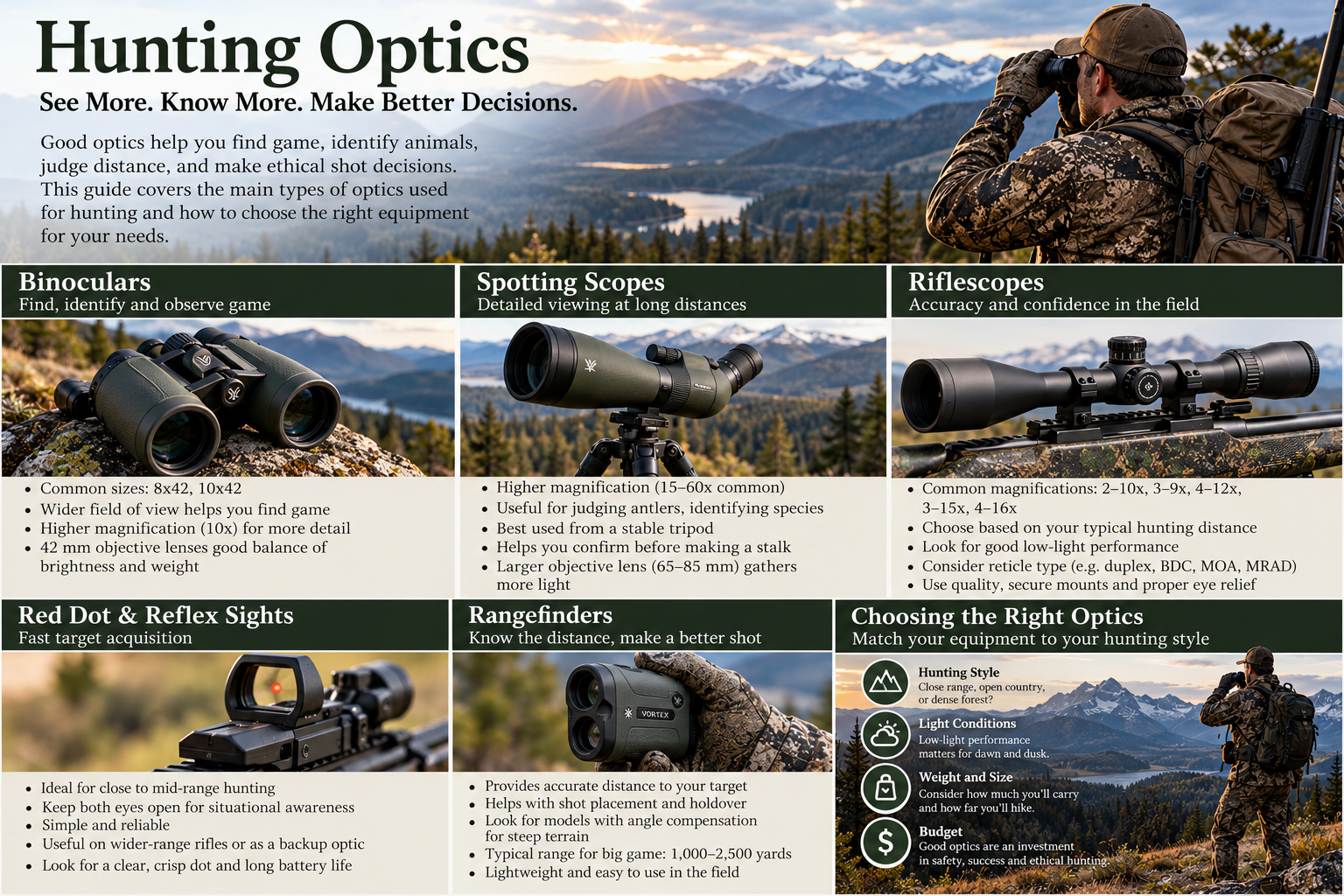
Optics help a hunter observe, identify, range and aim more precisely, but each tool has a different job. This guide separates binoculars, spotting scopes, rangefinders and riflescopes, then explains scope features and reticles without pretending one setup is best for every hunt.
 Open full-size image ↗
 Open full-size image ↗
 Open full-size image ↗
Start with the job
Binoculars are the primary general observation tool. Spotting scopes add magnification for detailed observation from a stable position. Rangefinders measure distance. Riflescopes are aiming devices attached to the firearm and should not be used as substitutes for binoculars when searching or identifying.
Know the main riflescope parts
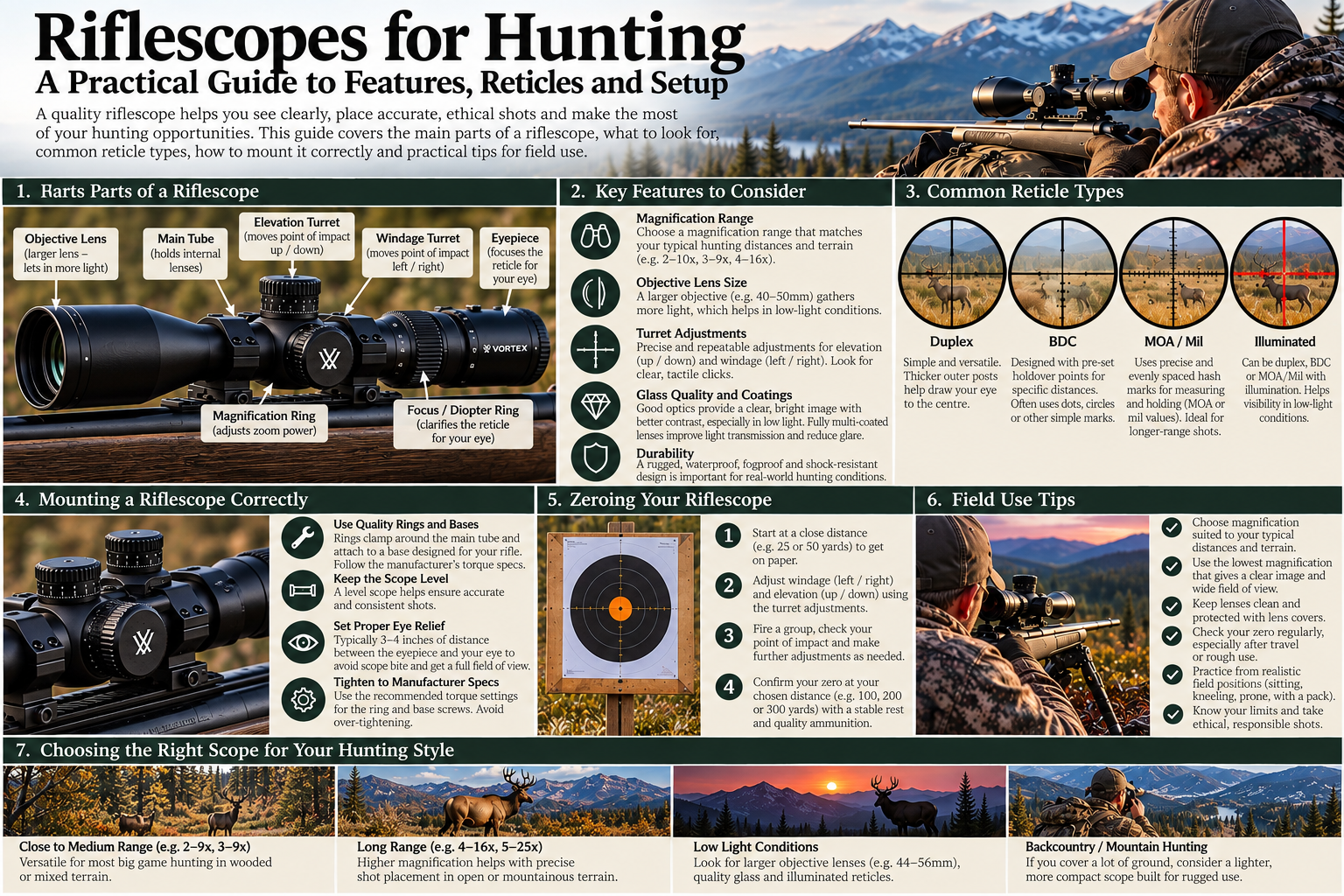
Understand the objective, main tube, magnification ring, ocular or eyepiece, diopter or focus, elevation and windage controls, and any parallax or illumination control fitted to the model. Eye relief is the working distance between the eyepiece and your eye that gives the intended sight picture.
Magnification is a tradeoff
More magnification can reveal detail but narrows field of view and can magnify movement. Lower power can make target acquisition and positional shooting easier. Useful magnification depends on terrain, distance, stability and the individual optic rather than a universal hunting number.
Reticles solve different problems
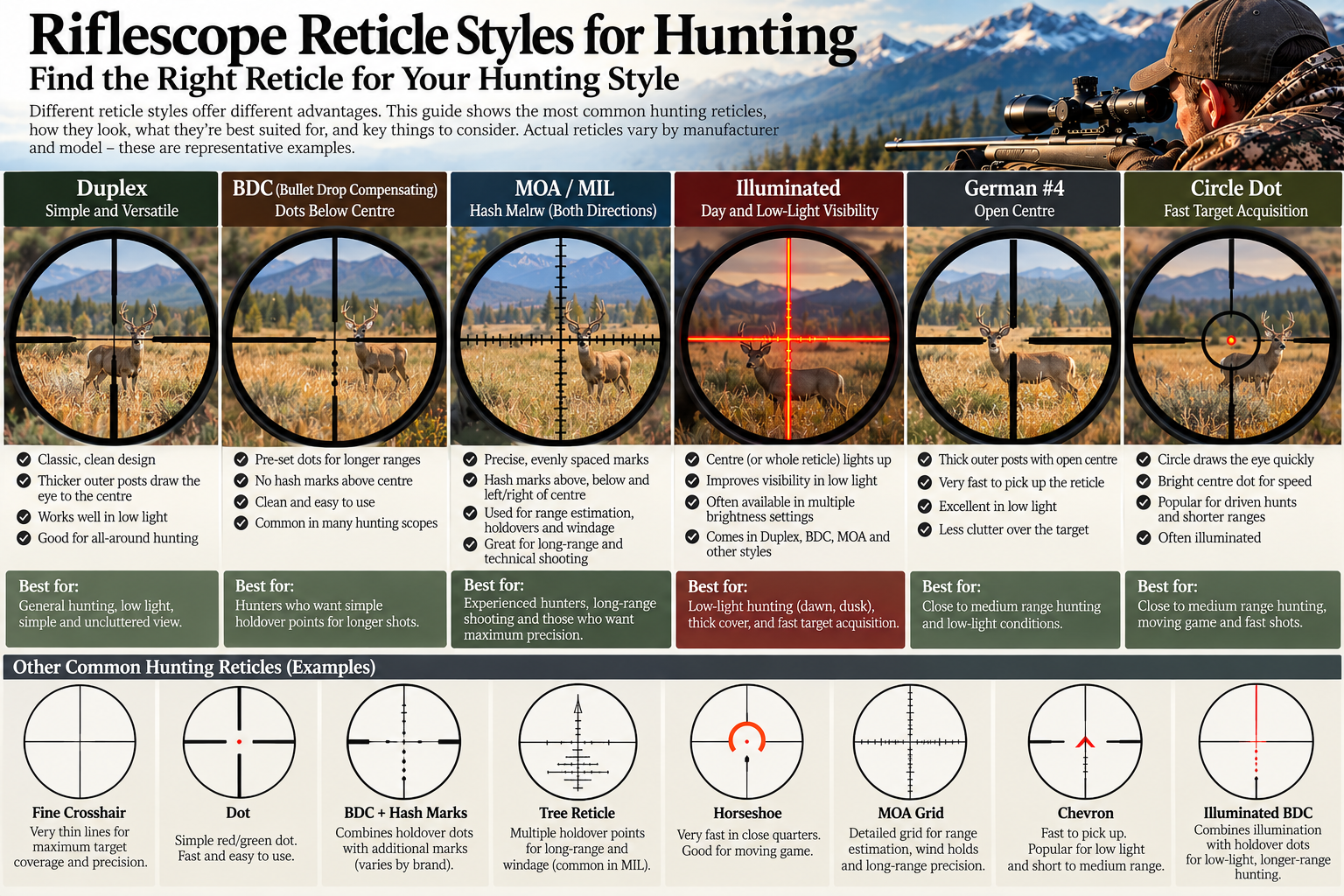
A duplex reticle emphasizes a simple central aiming reference. BDC designs add manufacturer-defined hold references, commonly below the centre. MOA and MIL reticles use angular graduations for measured holds or corrections. Illuminated and other hunting reticles can improve visibility in some conditions. None is automatically best; learn the exact reticle in the optic you own.
BDC is not a universal distance scale
A BDC mark only corresponds to a useful trajectory when the manufacturer's assumptions and your actual setup are understood. Cartridge, load, muzzle velocity, zero, atmospheric conditions and sometimes magnification can affect the relationship. Verify the holds at the range rather than treating printed distances as proof.
MOA and MIL are angular systems
MOA and milliradian systems describe angles rather than specific cartridges. They can be used to express scope adjustments and reticle subtensions. Keep the turret and reticle system understandable to you, and confirm what one click and each reticle mark mean on your exact optic.
Mounting and eye relief come before zero
The scope needs secure compatible mounting and a comfortable position that provides a full sight picture without forcing your head forward. Follow the firearm, base, ring and optic manufacturers' instructions and torque guidance. A mechanically secure system is the foundation for meaningful zeroing.
Zero, then prove the system
A zero established from a stable position is the starting point. Confirm repeatable groups, record the exact ammunition, and then test the setup from realistic field positions and distances. If the optic or mounts are disturbed, the rifle is struck, or point of impact changes unexpectedly, investigate and reconfirm.
Use optics to improve judgment
Good glass should help you identify animals, read terrain and decide whether to get closer or pass. Seeing an animal clearly at long distance does not make the shot appropriate. Observation capability and demonstrated shooting capability are different things.
This site is free — brand partnerships coming soon.
General educational information only. Always follow current local hunting regulations and verify ammunition performance with the manufacturer.