
Shot Placement & Shot Angles
Ethical shot placement starts with anatomy, angle and margin for error. The goal is not merely to hit the animal, but to choose a presentation that gives the largest practical path through vital organs while preserving a realistic recovery outcome.
 Open full-size image ↗
Start with anatomy, not an exterior aiming dot
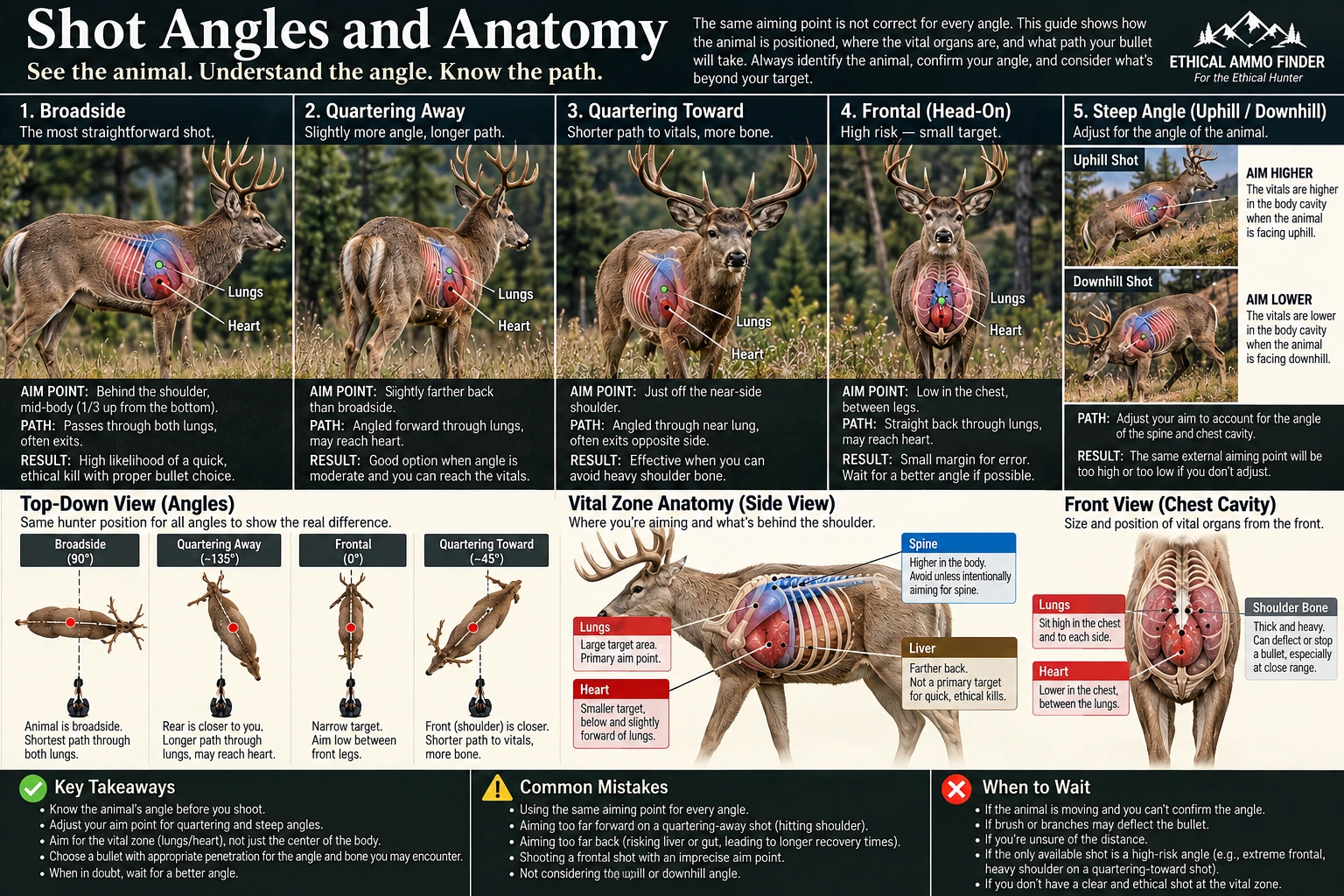
For deer-sized big game, the heart and lungs occupy the chest behind and around the shoulder structure. Learn where those organs sit inside the animal rather than memorizing one point on the hide. The anatomy and shot-angle graphic above connects the outside view to the lungs, heart, shoulder and major skeletal landmarks so the intended path through the animal is easier to visualize.
Broadside gives the clearest margin
Hunter-education guidance commonly treats a broadside presentation as the clearest large vital-area opportunity on deer-sized game. The important idea is margin for error: the chest presents substantially more vital area than small targets such as the head.
Angle changes the path through the animal
Quartering presentations require thinking in three dimensions. The visible aiming point is only the entry point; consider the path needed to reach the vital organs. If the angle, foreground or background makes that path uncertain, waiting for a better presentation is part of shot placement.
Why head shots are controversial
A perfectly placed head shot may cause immediate incapacitation, which is why some hunters consider it. The trade-off is a much smaller target that can move abruptly, with severe wounding possible when the shot misses the brain but strikes the jaw or face. A solid rest, close distance and demonstrated accuracy can reduce shooter error, but they do not make the target larger or prevent sudden animal movement. For that reason this guide does not present head shots as the default big-game aiming choice.
Stability does not rescue a poor presentation
Bipods, prone positions, trees and other solid rests can improve shooting stability. They should be used to increase confidence in an otherwise responsible shot, not to justify a small target, bad angle, obstructed vital area or distance beyond demonstrated ability.
Know when to wait or pass
A rear-end presentation offers no large vital target. Head-on and steep quartering angles can sharply reduce margin for error or increase the amount of tissue and bone between the entry point and vital organs. The animal changing position is often the best solution.
Connect placement to ammunition performance
Shot placement and ammunition selection cannot be separated completely. Bullet construction and impact conditions affect penetration and expansion, while anatomy and angle determine what the projectile must pass through. Hunt Match can help compare ammunition, but it cannot decide whether the animal is presenting a responsible shot.
Plan the recovery before firing
Even a carefully chosen shot carries uncertainty. Mark the animal's location, watch its reaction, note the last place it was visible and be prepared to follow up methodically. Shot placement is part of a chain that continues through recovery and meaningful use of the animal.
Canadian and U.S. context
Hunter education is jurisdiction-specific, but the responsibility themes overlap. British Columbia CORE formally includes outdoor ethics, game care, firearm handling, conservation and wildlife management; Ontario hunter education includes safety, responsibility, hunting techniques and wildlife identification; Northwest Territories hunter education explicitly emphasizes reducing wounding and wastage and encouraging full use of harvested animals. U.S. hunter-education material likewise emphasizes vital-area knowledge, appropriate shot angles and recovery. This guide synthesizes those principles rather than treating one jurisdiction as the North American standard.
Educational scope
This resource teaches decision-making and anatomy, not a guaranteed aiming formula. Species anatomy varies, field conditions change quickly, and current hunter-education and wildlife-agency guidance should take priority for the place and species being hunted.
This site is free — brand partnerships coming soon.
General educational information only. Always follow current local hunting regulations and verify ammunition performance with the manufacturer.